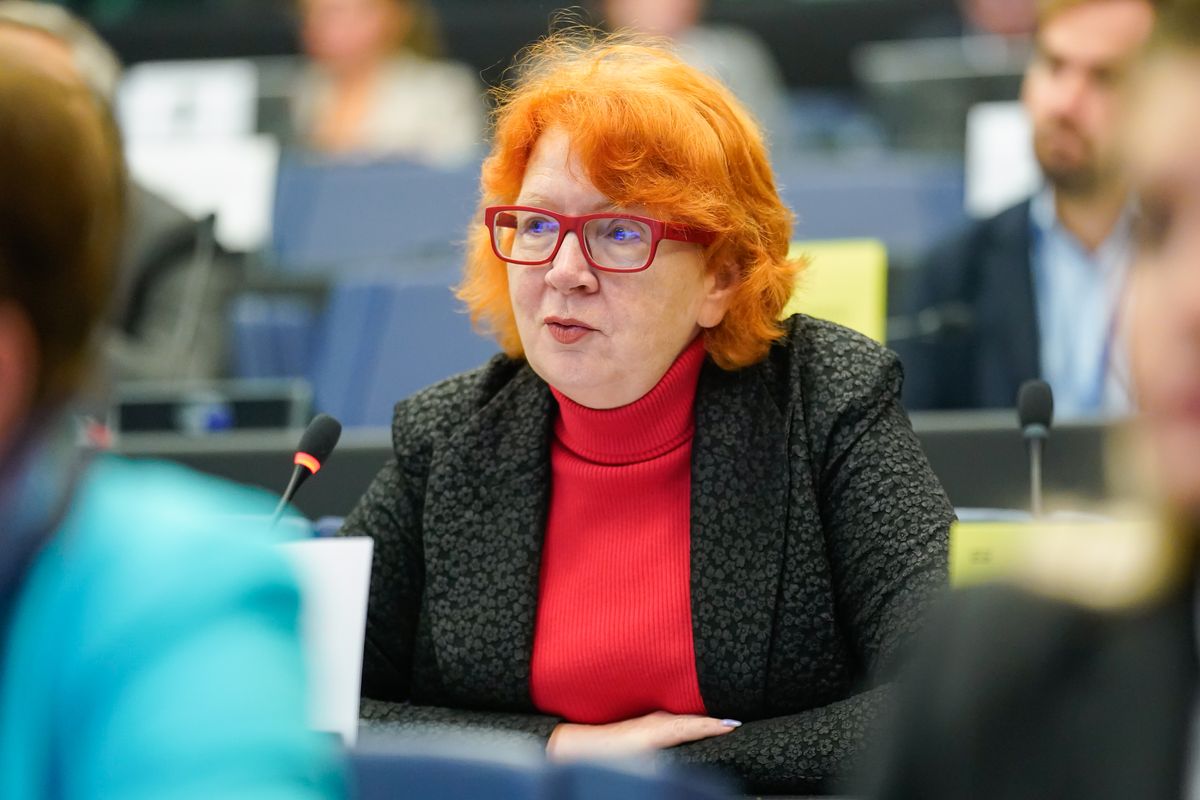
Last week, the main event was once again the trilogue. It was a tough process, lasting many hours and ending at midnight. Still we managed to reach a good compromise.
Monday, 11 May, began as usual with the programme ‘10 Minutes with Yana Toom’ on Radio Maximum where we spoke about Europe Day, and I also answered questions from listeners.
I spent the rest of the day flying. Tuesday in Brussels began early with a series of working groups; I also took part as a keynote speaker at the conference ‘Developing a Just Transition’, organised by the Institute for European Environmental Policy (IEEP). This institute monitors the just transition in 11 countries – unfortunately not in Estonia, but they have promised to include it in their review. The IEEP are green activists; they are primarily interested in the environmental aspect, and know less about the social side of the transition. That is what we discussed: how we might avoid ruining the economy in the process of transition.
The third working group’s meeting had finished by the evening, but the working day wasn’t over yet; on the contrary, there was another trilogue ahead. As a reminder, this is the name given to the three-way negotiations between the European Parliament, the European Commission and the Council of the EU regarding a particular directive. My previous trilogue took place less than a month ago; at that time we agreed on the directive on the coordination of social security systems. This time, the subject of discussion was the directive on the protection of adults – I am the main rapporteur on this.
This concerns people who are recognised as having partial or full legal incapacity, and how to standardise the rules for dealing with such people across the EU. There is a UN Convention which requires that, where possible, the views of such adults be taken into account. We want to move in precisely this direction because, unfortunately, there are quite a few cases in EU countries where these adults are placed in various institutions without being asked, even though, in principle, this could and should have been done.
The trilogue lasted over six hours. We argued a great deal, including – as always – about the words ‘may’ and ‘shall’. I stood by ‘shall’, whilst the Council of the EU insisted that there was no need to impose obligations on countries. For the most part, we managed to retain ‘shall’. A compromise was reached; the only concession we made was on the register of vulnerable people: a number of EU countries are opposed to it; they do not want to maintain it, fearing data leaks, and are not technically ready for it. The negotiations were tough; at one point, representatives of the European Parliament’s Social Democratic group said: no, let’s call it a day, we’ll try again in the autumn when Ireland holds the EU Council presidency. But in the end we managed to reach an agreement – thanks to the current EU Council presidency, Cyprus.
The fact that Tuesday turned out to be an irregular working day was partly made up for by Thursday. In Belgium it is a public holiday, Ascension Day, and the European Parliament was closed. It so happened that I had a recording slot on ETV+ on Wednesday evening. If Thursday had been a working day, I wouldn’t have been able to take part in the recording, but as it was, I managed to fit everything in. The result, the talk show ‘Epicentre’, in which we discuss the presidential elections in Estonia, will be broadcast this Wednesday, 20 May. This does not, however, mean that I was resting on Thursday: I had a meeting of the Tallinn City Council, which, incidentally, was not a short one. On Friday, I met with voters at the flower market in Türi. Plus a few party meetings, of course.
I spent Sunday in the air again so that on Monday morning I could drive from Brussels to Strasbourg in time for the start of the European Parliament’s plenary session and hold a few working meetings before the session began.