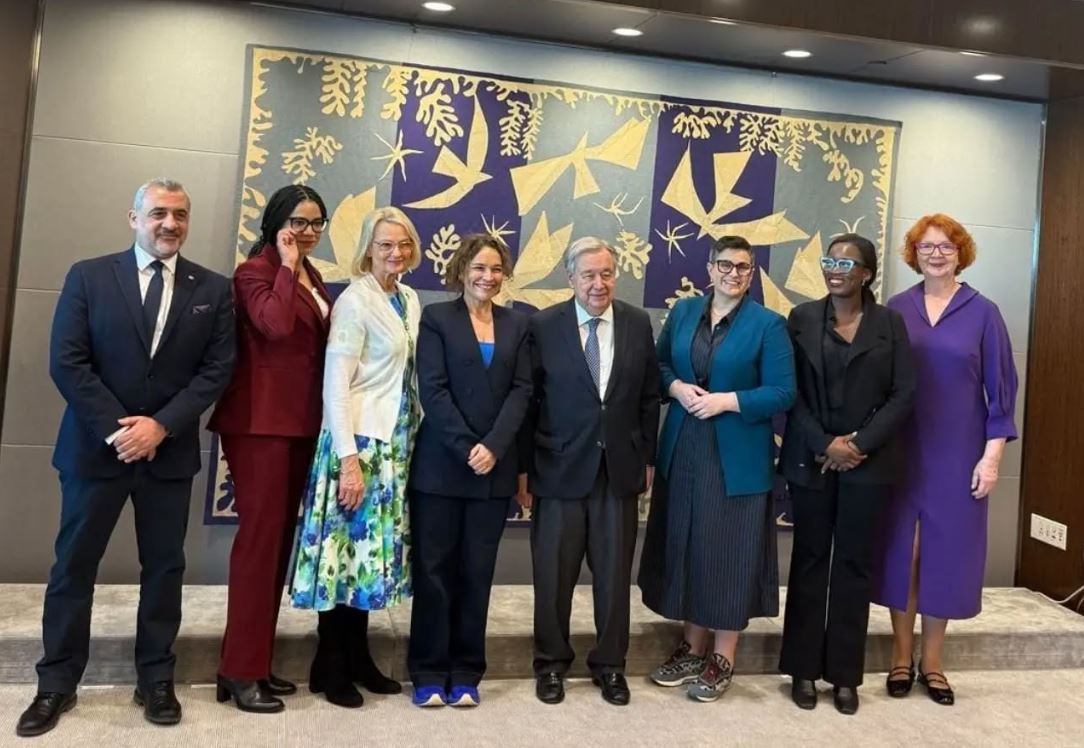
Last week was an ‘American’ and ‘women’s’ week for me – from Monday to Thursday I was on a mission for the Committee on Women’s Rights and Gender Equality (FEMM) in New York, attending the 70th session of the UN Commission on the Status of Women.
It is, of course, more accurate to speak of human rights – this is precisely what the UN Commission on the Status of Women deals with, as these rights apply to a specific and often discriminated-against section of the population. I know that this is a controversial topic for many. And I shall perhaps answer straight away two questions that have surely occurred to the reader.
First: is it necessary to talk about women’s rights in Europe, where the situation seems normal – after all, this isn’t Africa?
It is. Yes, the situation in Estonia in particular and in the EU in general is not comparable to that in African countries, where female genital mutilation is a normalised practice and there are huge camps for women who have been raped in utterly horrific ways. Nevertheless, things could be much better here too. Issues such as the gender pay gap (Estonia is the worst in Europe) and the failure to recognise rape as a criminal offence when a woman, out of fear, did not explicitly express her refusal, were also discussed at the session. The fact that these problems sometimes seem less serious does not negate the fact that they are still problems – and they need to be resolved.
Second: why discuss anything at the United Nations? Everyone knows that the UN is over and doesn’t solve anything.
No, that is not the case. The UN certainly has its problems; these are particularly evident against the backdrop of wars and invasions that no Security Council can stop – be it in Ukraine, Venezuela or Iran. However, the UN is an organisation that does a great deal in the humanitarian sphere. We have a slightly different perception of the UN precisely because the situation in Estonia is better; we are part of the ‘golden billion’, albeit the poorest part. But in Africa, the UN is perceived quite differently. From Estonia or Belgium, this isn’t so noticeable, but in New York at a UN session I saw many delegates from very poor countries, and these people say that if it weren’t for the UN, their countries would be suffering far more.
The session of the Commission on the Status of Women itself is devoted to the same thing every year – the adoption of a resolution which, in essence, becomes an action plan for the year, both for the UN and for the countries willing to listen to the UN. The fact that the UN is an important organisation is also evidenced by the intrigue that unfolded during the session. Usually, the resolution is adopted by consensus. The US, aware of this, decided to intervene in what they saw as a foolproof way – they tabled amendments to make it impossible for the resolution to be adopted in its original form.
The amendments were surprising, in the spirit of Trump’s battle against ‘wokeness’ the US removed the words ‘gender inequality’, demanded a definition of the term ‘woman’, and so on. However, the ploy failed: the amendments were put to a vote as a single package, and no one supported them. In the end, the US voted against the resolution, almost everyone else voted in favour (a couple of countries abstained), and the resolution, albeit not by consensus, was adopted.
So, if the UN had no influence whatsoever, the attempt to scupper the resolution would have been pointless. So, the UN is more alive than dead. And so alive, in fact, that the Trump administration views this organisation as an adversary.
Of course, over the few days we haven’t just been sitting in the session itself, we’ve been meeting all sorts of people. One of the meetings that impressed me most was with UN Secretary-General António Guterres (on the photo). Another was with the head of the family planning agency, an African woman who spoke vividly about what is happening on her continent. ‘Unlike our opponents, there are many things we cannot even speak openly about,’ she said, ‘because they are very intimate matters, they are horrific, they are taboo...’
Generally speaking, everyone was saying the same thing – all over the world, including Europe, there is a regression in terms of human rights. This is a fully coordinated campaign organised by right-wing radicals. There is a great deal of lies and ‘smoke and mirrors’, behind which human rights seem to be lost. If this continues, the day will come when the principle that ‘a woman should know her place’ will no longer be considered discrimination. It is good that, for now, there are still enough people fighting against this nonsense.